

|
Blog |
 Why Following a Script Isn’t the Best Way to Teach Your Child to Read and WriteI am often asked why my Phonics reading and spelling/writing programme, Reading Made Simple, is not fully scripted so that parents can read each lesson to their child. I have written this post to explain why, but this lesson is not restricted just to my programme. This is a lesson in being a good teacher, and it is helpful whichever phonics programme you are using. In today’s world, it seems like every parenting forum, educational book, and online resource comes with step-by-step, scripted activities. Parents want everything carefully laid out — word-for-word prompts, step-by-step instructions, even the exact questions to ask. It’s understandable. We all want to “do it right,” especially when it comes to helping our children learn to read and write. But here’s the truth: rigid scripts are not the key to effective learning. Real teaching requires understanding, observation, and adaptation — skills that no script can fully capture. Every Child Learns DifferentlyNo two children learn in the same way. Even children of the same age can respond very differently to the same activity:
The Art of TeachingTeaching is more than delivering instructions. It’s an art — a combination of knowledge, empathy, and creativity. Good teachers:
Why Understanding the Learning Process MattersWhen parents understand the principles behind the activity, they can adapt it for their child:
This approach encourages confidence and enjoyment, which are crucial for long-term literacy development.  Stories that children love and no curve balls to throw them off track! Tried and tested on real children! Why Scripts Can Be LimitingFully scripted activities can be helpful as a starting point, but they have significant limitations:
How Parents Can Adapt Activities EffectivelyHere are some practical ways parents can make activities work for their child without needing a full script:
 Try the first Reading Made Simple Level 1 lesson for free! No risk - no sign-up! Encouraging Confidence and IndependenceOne of the biggest advantages of adaptive teaching is that it helps children develop independence. When children see that they can solve a problem, figure out a word, or complete a sentence with guidance rather than rigid instructions, they:
A Real Example from My ClassroomIn my teaching experience, I’ve seen children who were initially reluctant to write short sentences quickly gain confidence with gentle daily practice:
Conclusion: Teaching is an Art, Not a FormulaScripts can be useful starting points, but the true skill of teaching lies in understanding, observing, and adapting. By learning the principles behind phonics and literacy activities, parents can tailor them to their child, creating a learning experience that is engaging, effective, and confidence-building. In short, teaching is an art. By focusing on your child’s needs rather than following instructions word-for-word, you give them the gift of skill, confidence, and a lifelong love of learning. Tip for Parents: The Complete Reading Made Simple CurriculumDesigned for teachers, this is the ultimate Structured Literacy course to meet the needs of the WHOLE CLASS - even the LOWER THIRD! Get the first lesson free, above, as a trial. If you have older struggling readers, then please see our special needs reading scheme - real stories based on history.
 This post contains affiliate links. Decodable Readers for SEN Pupils: Simple Steps to Reading SuccessTo watch a child, who has previously struggled to read achieve that much coveted skill, even if it is only to read a very simple word like 'bus', all by themselves, with no guessing from a picture - to know that they are really reading and not just 'making it up' - is a very special moment. Of course, for the child, it is far more than a moment and it is no small thing, for it signifies a means to escape from illiteracy, shame and low confidence - for life. My job is to create these moments. I work with children who the world labels SEN. SEN stands for special educational needs. I prefer to refer to my pupils as those who learn differently, for every child is unique and all have some special needs but it is a fact that some children do have greater difficulty learning to read than others. This difficulty does not regard intelligence: it can affect children across the intelligence range. The shame these pupils feel is palpable: many have long struggled, and failed. Few teachers really understand their difficulty and they are often labelled 'lazy'; their true difficulty pushed under the carpet. And yet - just because they have struggled, I find that these children have a resilience not found in those who learn seemingly effortlessly: they are fighters and given the right help, albeit slowly, they can make much progress. But key to their success is one vital tool which must be in every teacher's tool kit, and that is Decodable readers. Without decodable readers that are written to match the phonic course of instruction you are using, you will make little progress and only frustrate the pupil more. Decodable readers give the child who learn differently a step by step, solid ladder from which to escape illiteracy. But not all decodable readers are created equal.
What Are Decodable Readers?Decodable readers should be books that only use the words with sounds a child has learned already to sound out. In short - the words are decodable. Any pictures in the books should not encourage guessing, as guessing is what causes children to fail. Decodable readers must:
An example from a decodable book might be: Tam has a dog. Tam and the dog got in the van. There might be a simple picture of a man and his dog, possibly on the next page, as a reward for sounding out the text, but not to help 'read' the words. A natural language book, on the other hand, might have a picture of Tam and his dog getting into the van on the same page as the text and might have the following text written underneath: Tam and his dog Benjy jumped in the van. The words Benjy and jumped would be too hard for a child who was only at the stage of sounding out Tam and dog. This is called a 'predictable text': the child can work out the text by looking at the picture.  Why the Reading Made Simple Decodable Readers are uniqueMy decodable readers are quite unique. Let me explain why. The standard decodable readers that you can purchase will be based on the following principle: first you teach a new sound, and then you presume that the child can sound out any word containing that new sound (providing of course the child is blending at this point). So, for example, if we taught a child the sound 'ee', then we can presume that the child can sound out the following words: feet, see, meet, tree, bee, feel, sleep, creep, and many more. In theory, this would be fine, and works for the average student. However, I have learned that the child who learns differently has another problem: they find it very, very hard to recall words they have previously sounded out. Added to this, I have learned that many SEN pupils struggle with what I call 'confusion words'. These are words which have:
The end result of this is that they never achieve reading fluency - and reading comprehension becomes elusive, even when using a decodable reader. So the Reading Made Simple Decodable Readers have an extra feature.  The unique feature of the RMS decodable readers for SEN pupilsThe Reading Made Simple reading programme has a basic set of readers which can be used by most pupils, including those with SEN, but it also has a unique set of decodable readers for pupils who struggle with the points listed above. As we learn each new sound, we first apply it to as many words as we can, but then focus exclusively on an initial bank of ten words which the child will meet again, and again, and again in the reading books. Therefore the number of words using each sound is limited. This allows the child time to become so familiar with them that sounding out is no longer necessary. In time, and very slowly, so as not to cause to the child to regress, we add more words from each sound family, while adding new sounds.  How the RMS Decodable Readers Support Phonics LearningThe Reading Made Simple reading course is designed to reduce mental overload on the child. My series of decodable readers for SEN reduce it even further. Each book has a unique set of matching worksheets which:
These books have been written for real pupils and tested on them. Before I publish them I make sure that any words or sentences that may cause problems have been removed and rewritten. In all the RMS decodable readers make learning to read like having a ladder to climb a mountain instead of chancing scrambling up the scree, with many backward slips. Thankfully, my pupils know that they teach me as much as I am teach them, so they do not mind being my 'editors'. In fact - they regard it as a highly privileged role!  Why SEN Pupils Benefit from the RMS Decodable ReadersThe RMS decodable readers have been proven to provide SEN pupils of all abilities a dependable route to reading fluency. Each pupil can go at his/her own pace - a pace that they can manage and which builds success. For any student with dyslexia, autism, or processing difficulties, the Reading Made Simple decodable reading books a make learning less stressful: 'I can't' with a frown, becomes 'I can' with a huge smile. They help to make teaching so rewarding. As an added bonus, the programme also doubles as a spelling/writing curriculum with dictations designed as per the reading books - only using the bank of ten words learned for each sound family - all especially geared for the SEN pupil.  Non-babyish decodablesThe RMS readers have another secret: they are not at all babyish. No cats and dogs - but real history. It is advised that 'Our Island Story' by H. E. Marshall be read alongside the series, giving background information and helping the pupil make sense of the time period they are reading about. Project work could also be carried out alongside reading the books about each era.  ConclusionChoosing decodable readers for SEN pupils is not an easy task. To consider spending a lot of money only to find it has to many 'curve balls' for your pupil, or goes too fast, is a huge consideration. Plus, many of the programmes are made for school use and fat too complicated and expensive for use by parents. The Reading Made Simple decodables for SEN overcome all of these hurdles. I trust you will not be disappointed. The Reading Made Simple Decodables are FREE to download from the website, without the worksheets, and if you want the worksheets I am keeping the price as low as I can and you can find them either on TPT (as a growing bundle - pay the price you see and get all the rest of the series for no extra cost) or on Teach Simple. You can try before you buy with a free sample here. Try a FREE lesson today!Because we are so confident in our programme, we are allowing you to try the first lesson for free. Click the picture below to download!
Reading Made Simple: a phonic reading and spelling curriculum for all ages and abilities including SEN and dyslexia |






 |  |


Is your child a late talker?
It can be very worrying if your child does not start to talk when expected, approximately between the ages of one and two. Not only is it worrying, but it is not uncommon for other people to suggest that you have not talked to your child enough, or that it is in some way your fault! This can be very hard to take, along with watching other proud parents boasting of how well their child can talk - and some at such a young age.
For your comfort I tell you that this is not necessarily the case. You may speak to your child much. However, do check this one point first as it is easy to think you are talking - but maybe not as helpfully as you could be for the needs of your child, We will think more about that in a minute.
I have helped children who have very clever parents, to those ordinary mums who are just doing a good job - and late talking is not choosy - it can happen to anyone's child!
I am a teacher - and it happened to me!
Neither does the fact that your child is late talking mean that s/he will not be clever - some of the cleverest people have been late talking. however, my work with such children tells me that they have a high chance of needing more help to learn to read and write - and that is why I wrote my special reading programme - Reading Made Simple.
More - you are not alone as there seem to be increasing numbers of children who are late talking.
Your child may be referred for speech therapy.
Depending on the area in which you live, there may be a long waiting list to receive help.
When you receive help, you may be disappointed, as no-one can make your child talk!
Your child will talk when sh/e is ready to talk.
So how can I help my child to talk?
Do not despair as there are many things that you can do to help your child.
Here are some ideas that I have collected while working with parent's of late-talking children. I wish I had known them when my own son was late talking!
Help the child to understand
This is the most important thing to remember when you have a child who is late talking: concentrate first on helping the child to understand. As parents we all too often presume that our children understand as they hear - and forget that the child may not understand. We want words, but before a child speaks, they must have a reason to speak and understand what they want to say.
Communication is not just words, but words with meaning.
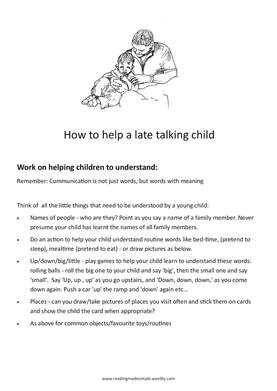
Think of all the little things that need to be understood by a young child:
Maybe one day your child will pick the correct 'place' picture from the box when you say you are going to the shops, for example. This will show understanding and it is a wonderful feeling to know that you are able to communicate with your child in this way.
- Names of people - who are they? Point as you say a name of a family member. Never presume your child has learnt the names of all family members.
- Do an action to help your child understand routine words like bed-time, (pretend to sleep), mealtime (pretend to eat) - or draw pictures as below.
- Up/down/big/little - play games to help your child learn to understand these words: rolling balls - roll the big one to your child and say 'big', then the small one and say 'small'. Say 'Up, up , up' as you go upstairs, and 'Down, down, down,' as you come down again. Push a car 'up' the ramp and 'down' again etc...
- Places - can you draw/take pictures of places you visit often and stick them on cards and show the child the card when appropriate?
- As above for common objects/favourite toys/routines
Maybe one day your child will pick the correct 'place' picture from the box when you say you are going to the shops, for example. This will show understanding and it is a wonderful feeling to know that you are able to communicate with your child in this way.
Use short sentences and speak slowly
Very often we chatter away to our child when they are babies - and that is good, but when they reach the age of needing help to speak, we need to slow down and speak more concisely. When a child starts to speak without help, we naturally find ourselves repeating words: '"Cup?" "Bed," etc...
However, it is much harder to do this if the child has not yet started speaking.
It is even harder if it is our first child and sh/e is seemingly getting too old for 'baby talk'.
Try to listen to the way you talk to your child. You might find that you are using quite complicated sentences.
Late talkers are often children who come to me, when they are a bit older, with reading difficulties - I then find that these children often process information at a slower speed. They find it hard to concentrate for very long and need things broken down into tiny, tiny steps.
That is what they need now, to help them to learn to talk. You will need to help structure their learning for them.
What to do?
Use shorter phrases or single key words and avoid long complicated speeches. Be prepared to repeat the key part of each sentence/phrase:
'Coat - coat on.' Show the coat and make moves to help the child into it.
'Do you want a drink? Cup - drink?' And show the cup and mime drinking.
The speed of the parent's speech matters. We tend to speak too fast for some of these children to be able to get the meaning of what we have said.
Only give one instruction at a time
Keep instructions brief and only one at a time.
For example, "Let's put the toys away and then we will have dinner." is two instructions - too many for little minds to process.
Instead break it into two parts. "Toys away," and help put the toys away so the child learns what you mean.
Then say "Dinner," and lead to the table for the meal.
If it is an instruction of correction, then help the child to follow though on it. For example, if the child is doing something that should not be done, then say 'Stop," and then follow through to make sure s/he does stop.
Remove distractions
Because late talkers often later show difficulties concentrating, it stands to reason they had it when younger. How can they concentrate on what you are saying it there is a lot of 'noise' in the background?
- Turn off music and TV. Even silent pictures can distract and can create what we call 'noise' - anything that takes attention away from the task in hand. You can live without a screen. At best, children cannot learn with only half their focus - even less these children having difficulty learning to speak.
- Speak directly, face to face to the child - do not shout across a room and hope s/h e will hear and understand.
- Keep your mobile phone use to the minimum. Think of it like this, The whole time you are on your mobile you are in fact 'out of the house' - away from your child - even if sh/e is sitting right there next to you. Your attention will not be on your child. Children are wired (by their Creator) to need communication. This means giving your child full attention - and not just to take a cute photo to paste on social media!
- Talk meaningfully to your child. Talk as though you love your child. Enjoy special times together. I am sure you think you love your child, but the sad reality is that if you cannot put your phone down to spend quality time with your child - your child will know the reality in his/her soul - s/he will feel unloved.
Listen!
Listen for any noises or sounds your child may make consistently for the same thing.
This is the beginning of speech. Pick up on it and repeat the word often, correctly.
If you do not know what word a sound represses, then just repeat it. This tells the child it is good and encourages him/her to keep saying it. One day it will become a word.
This is the beginning of speech. Pick up on it and repeat the word often, correctly.
If you do not know what word a sound represses, then just repeat it. This tells the child it is good and encourages him/her to keep saying it. One day it will become a word.
Spend focused quiet time with your child
Read plenty of books - let there be unhurried time for you to spend together so that the child has time to process the information presented. Slow life down - these children are often over-stimulated - there is too much for their brain to process. Keep life simple!
Children do not need constant activity. Leave them time and they will learn to amuse themselves.
Give natural toys - bricks, car, dolls etc.... rather than characters linked to movies - as these have little real meaning for a child outside of the fantasy world which they do not live in.
Play with your child - speak as described above.

Remove processed foods from your child's diet
Remove toxins from your home
Remove toxins from your home
Research now shows that children with special needs at any stage of their life have a damaged gut. Ultimately you might want to look into healing the gut, for which I recommend Dr. Natasha Campbell-McBride's GAPS diet.
In the meantime, remove processed food and as a family eat as naturally as possible - full fat foods (as the brain needs saturated fat to function at its best, not least for children).
Remove as many toxins as you can - these can come from washing powders, household cleaners, bubble bath, etc...
Use plain liquid soap in the washing machine, and vinegar in a spray bottle, half and half with water makes a good kitchen and bathroom cleaner.
Dr Mc Bride's advice for these children - and for us all is to only put on the skin that which we can eat!
A challenge but we can all do more to reduce those 'smellies' and lotions and potions if we try. She says the the skin is the bodies biggest organ and will let toxins through into the blood stream. When the gut is damaged, these toxins are passed into the body and can accumulate in the brain - where they can slow a child's development.
Much more help with these can be found online if you wish to explore this area further.
Take hope - one day your child will speak - and one day you will not be able to shut him/her up!!
(As if you would ever want to!)
(As if you would ever want to!)
This is what people used to tell me - and when your child is four and not talking you find it hard to believe.. But for us, it happened - as it has for many others.
Late talkers do not all suddenly start to make up for lost time - some do - but others still only slowly make progress - but take encouragement from every little tiny bit of progress, and look to take the next step. Avoid dwelling on all the things your child cannot do, as that helps no-one - least of all you.
Your child needs you!
Download our handy crib sheet to keep for easy reference
Welcome
Hello, I'm Lilibette, a qualified teacher (B.Ed Hons) with ten years in mainstream education, followed by home educating my two sons through to 18, and now working as a private tutor. This site brings together a wide range of phonics resources — games, worksheets, videos and more — for parents and teachers wherever they are in their phonics journey.
The majority are completely free. Where resources are paid, this is always clearly stated. My structured reading programme, Reading Made Simple, is available separately but shares the same philosophy: that every child deserves to become a confident, lifelong reader. Free resources are available to download — no sign-up needed — through my Teach Simple store.
Because reading is the bedrock on which all further learning is built, every child deserves access to it.
Categories
All
Ai
Ar
Blending
Ck
Classroom Assistants
CVCC Words
CVC Words
Dictations
Ee
Handwriting And Phonics
Home Education
How To Teach Phonics
Initial Sounds
Ir/ur/er
Letters And Sounds
Magic 'e'
Oa
Oo
Parents
Phonic 'How To'
Phonics Games
Phonics Worksheets
Reading Books
Reluctant Readers
SEN
Sh/ch
Silent 'e'
Special Needs
Speech And Language
Split Digraphs
Struggling Readers
Teachers
Understanding Phonics
Word Mats
 RSS Feed
We are a participant in the Amazon Services LLC Associates Program,
an affiliate advertising program designed to provide a means for us to earn fees
by linking to Amazon.com and affiliated sites.
This costs the purchaser nothing extra.
In this way I can continue to provide free resources.
Thank you for your support.
an affiliate advertising program designed to provide a means for us to earn fees
by linking to Amazon.com and affiliated sites.
This costs the purchaser nothing extra.
In this way I can continue to provide free resources.
Thank you for your support.

